
Selling on MercadoLibre from a single warehouse in Argentina usually means shipping to buyers in Buenos Aires, Córdoba, Mendoza and a dozen other provinces in the same month. For the provincial turnover tax, that one detail changes everything: your company stops being a local taxpayer and moves into the Convenio Multilateral (Multilateral Agreement), with its own registration, its own monthly return and its own way of splitting revenue between provinces.
We already covered the basics in our guide to turnover tax for online sellers. This article goes one level deeper and walks through the monthly process under the general regime, step by step, using the whiteboard explainer published by Argentine accountant Evelyn Muriel as a reference. The diagram below is our own version of her board, translated for foreign founders.
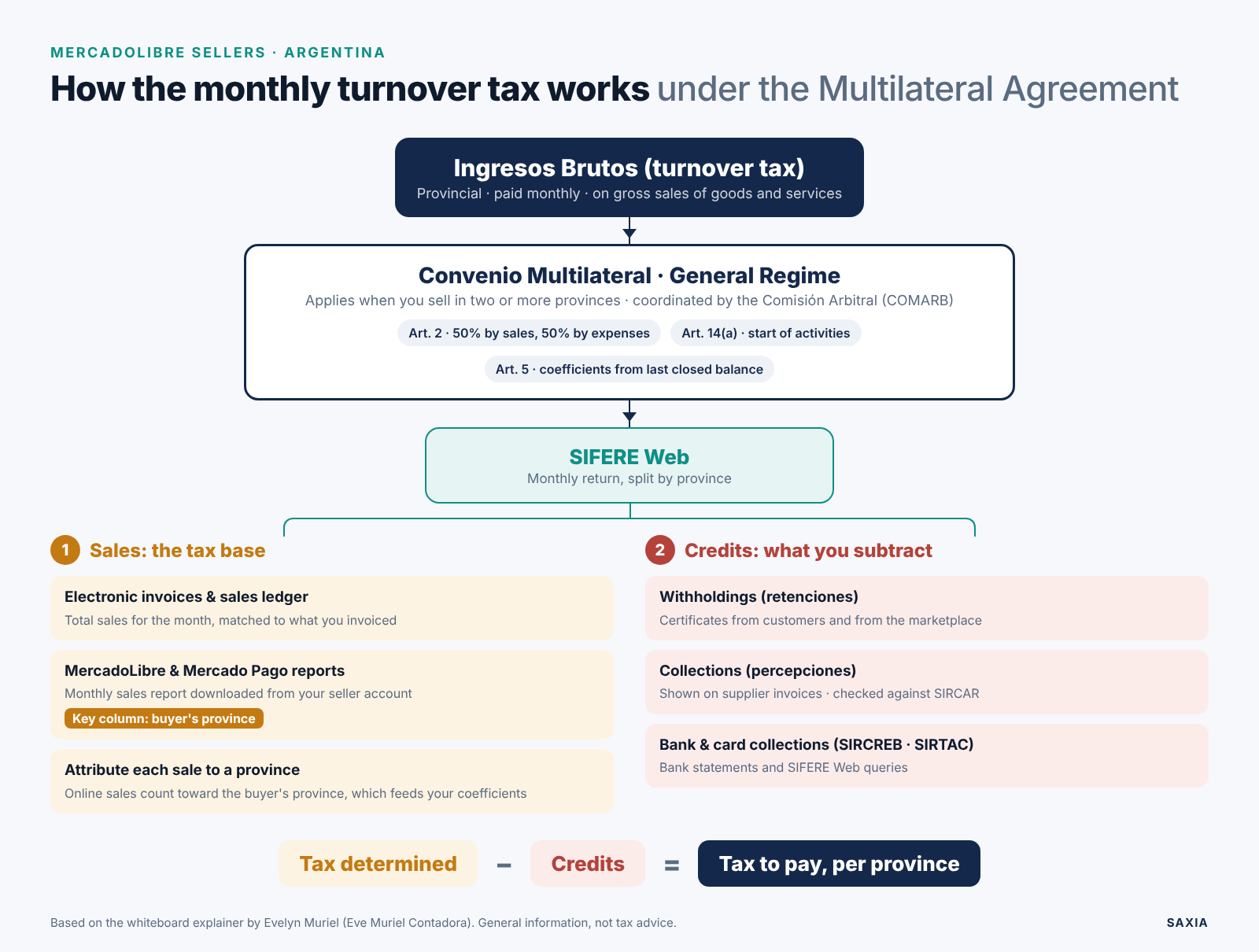
When the Multilateral Agreement applies to a MercadoLibre seller
Ingresos Brutos is a provincial tax charged every month on gross sales, whether or not the business made a profit. If all your activity happens inside one province, you register there as a local taxpayer. As soon as you carry out activity in two or more jurisdictions, the provinces agree not to tax the same revenue twice, and the Multilateral Agreement decides how much of your taxable base belongs to each one. The agreement is administered by the Comisión Arbitral (COMARB).
For marketplace sellers this happens almost immediately. Under the Comisión Arbitral’s rules on e-commerce, online sales are treated as transactions between absent parties, and revenue is attributed to the buyer’s jurisdiction when the seller has a real connection with it, including digital presence and expenses there. In practice, a seller with nationwide shipping is a multi-province taxpayer from the first weeks of operation.
How the general regime splits your revenue
Retail sales fall under the general regime of the agreement. Instead of a fixed percentage per activity, each province receives a share of your taxable base calculated with a coefficient. Three articles matter most for a new seller:
- Article 2: the coefficient for each province combines 50% based on the revenue attributable to it and 50% based on the expenses incurred there.
- Article 5: once the company is up and running, coefficients are calculated from the figures of the last closed financial year and applied to every monthly advance payment of the following year.
- Article 14(a): during the start of activities, when there is no closed balance yet, the base is assigned to each province according to the revenue and expenses actually generated there, until the company has a balance with enough activity to calculate regular coefficients.
This is why the first year is the most demanding one. A new company has no history to lean on, so every month’s return depends on knowing exactly where buyers and expenses were located.
The monthly process, step by step
1. Build the tax base from your sales
The starting point is total sales for the month, taken from your electronic invoices and sales ledger. For MercadoLibre sellers, the marketplace’s own sales report is the second source of truth. It lists every order with the publication, the price, the fees charged by MercadoLibre and Mercado Envíos and, most importantly, the buyer’s province. That single column is what lets you attribute each sale to the right jurisdiction.
Your invoicing and the marketplace report should tell the same story. Differences in amounts, dates or cancelled orders are exactly what provincial tax authorities cross-check later, so reconciling both sources every month is far cheaper than explaining gaps after the fact.
2. File the return in SIFERE Web
Multilateral Agreement taxpayers file a single monthly return through SIFERE Web, the federal collection system shared by the provinces. You enter the base, the system distributes it with your coefficients, each province applies its own rate for the activity, and the result is the tax determined for every jurisdiction.
3. Subtract withholdings and collections
Provinces collect a large part of Ingresos Brutos in advance, so before paying you deduct everything that was already taken from you during the month:
- Withholdings (retenciones): amounts kept by customers or by the marketplace when paying you, backed by withholding certificates. This is the answer to the question many new sellers ask: MercadoLibre withholds because provinces appoint it as a collection agent.
- Collections on purchases (percepciones): added by suppliers on their invoices and reported through SIRCAR.
- Bank and card collections: SIRCREB applies to credits in your bank accounts and SIRTAC to payments processed through cards and payment platforms. Both can be checked against your statements and in the SIFERE Web queries.
4. Pay the balance per province
The formula is simple: tax determined minus credits equals tax to pay, province by province. When credits exceed the tax, the difference becomes a balance in your favor in that jurisdiction. It can be used in later months, but if it keeps growing it is a sign that your coefficients or your registration need attention.
Common mistakes we see with foreign-owned sellers
- Registering as a local taxpayer and only moving to the Multilateral Agreement after months of nationwide sales.
- Ignoring the buyer’s province in the MercadoLibre report and assigning all revenue to the province of the warehouse.
- Not downloading withholding certificates and bank collection details every month, so credits are lost or claimed late.
- Letting credits pile up in provinces where the company barely sells, which ties up cash that should be working in the business.
Selling on MercadoLibre from abroad without the tax headache
For a founder outside Argentina, the monthly turnover tax cycle is usually the part that feels least manageable from a distance. Our Servicio para vendedores de MercadoLibre covers the Argentine company, the Multilateral Agreement registration and the monthly accounting that keeps SIFERE Web returns, withholdings and coefficients in order. If you want to review your current setup or plan a new one, request an initial assessment.
Preguntas frecuentes
Do I need the Multilateral Agreement if I only sell through MercadoLibre?
If you ship to buyers in more than one province, in most cases yes. Online sales are attributed to the buyer’s jurisdiction, so a single marketplace account selling nationwide usually creates activity in several provinces.
Why does MercadoLibre withhold turnover tax from my sales?
Provinces appoint marketplaces, payment platforms and banks as collection agents. The amounts withheld are not an extra tax: they are credits you deduct in your monthly SIFERE Web return.
Where do I find the buyer’s province?
In the sales report you can download from your MercadoLibre seller account. It includes a column with the buyer’s province for every order, which is the basis for attributing revenue to each jurisdiction.
This article is for general information only and does not constitute legal or tax advice. Provincial rules and collection regimes change often; confirm your situation with a professional before acting. Official information on the Multilateral Agreement is available from the Comisión Arbitral. Diagram adapted from the whiteboard explanation by Evelyn Muriel.

 English
 Español de Argentina
 Deutsch
 Português do Brasil
 Français
 Italiano
 简体中文
 العربية